
血管內皮生長因子受體-3配體結合域介導的信號在淋巴管新生和穩態維持中的作用
首發時間:2025-08-20
沈昕(1998-),女,碩士,淋巴管與血管生長調控
曹旭東 1 何玉龍 1何玉龍(1967-),男,教授,博導,血管與淋巴管生物學
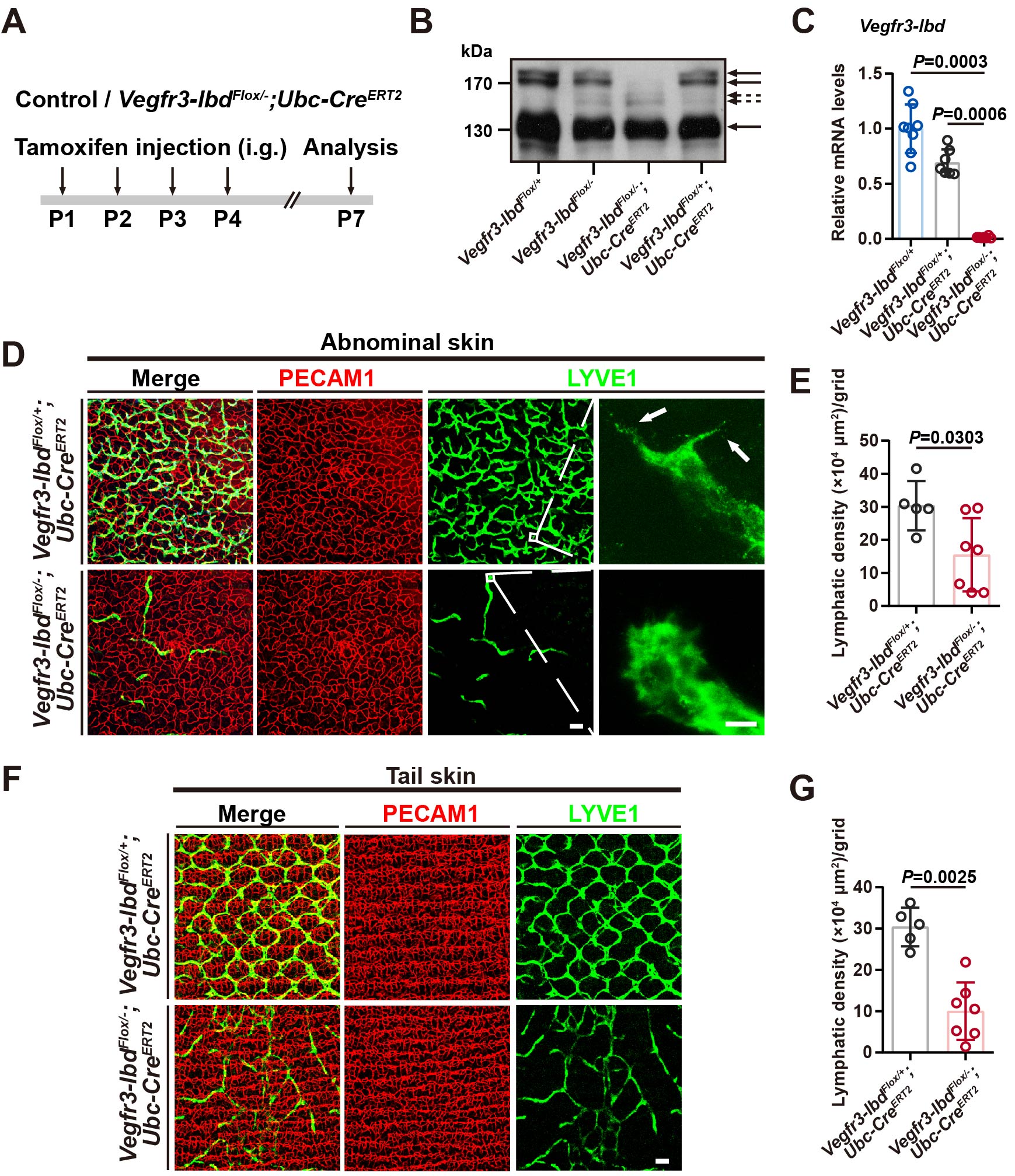
摘要:目的:血管內皮生長因子受體-3(VEGFR3)配體結合域介導的信號在淋巴管新生過程中具有重要作用,但其在淋巴管穩態維持中是否必需、以及不同組織器官中是否存在差異尚待進一步解析。 方法:利用全身性VEGFR3配體結合域敲除小鼠,通過在不同階段(新生兒期、青年期、成年期)誘導VEGFR3配體結合域敲除,分析皮膚、氣管、腸道與隔膜淋巴管生長與穩態維持的變化。 結果:利用免疫熒光染色分析方法的研究發現,出生后第 1 至 4 天(P1-4)誘導敲除 VEGFR3 配體結合域,導致淋巴管新生被抑制,表現為小鼠腹部及尾部皮膚淋巴管密度顯著下降,氣管內壁粘膜層的淋巴管前端延伸受阻,腸絨毛內淋巴管缺失,結腸內壁淋巴管數量明顯下降;與該表型相關,VEGFR3 配體結合域缺失導致淋巴管尖端內皮細胞發芽突起缺失。此外,雜合子小鼠(Vegfr3-lbd+/-)在出生后第1天顯示出背部皮膚和氣管淋巴管有增粗現象,提示VEGFR3 配體結合域缺失的突變體存在一定程度的顯性負性突變效應。在青年期(P16-21)誘導敲除 VEGFR3 配體結合域,導致小鼠耳部皮膚腹側面淋巴管密度下降,而隔膜、氣管及腸絨毛淋巴管形成未見明顯抑制。在成年階段(2月齡)誘導敲除VEGFR3 配體結合域后,除了在部分小鼠隔膜和皮膚淋巴管有增粗的現象,其他組織淋巴管的形態與網絡結構未見明顯異常。 結論: VEGFR3配體結合域介導的信號是新生淋巴管所必需的,但抑制VEGFR3介導的信號在短期內對于淋巴管穩態維持無明顯影響。
關鍵詞: 血管內皮生長因子受體-3(VEGFR3) VEGFR3 配體結合域 淋巴管新生 淋巴管穩態維持 條件性基因敲除小鼠
For information in English, please click here
Role of VEGFR3 ligand-binding domain-mediated signals in lymphangiogenesis and homeostasis
沈昕(1998-),女,碩士,淋巴管與血管生長調控
CAO Xudong 1 HE Yulong 1何玉龍(1967-),男,教授,博導,血管與淋巴管生物學
Abstract:Objective: While vascular endothelial growth factor receptor-3 (VEGFR3) is known to play a critical role in lymphangiogenesis, its ligand-binding domain (LBD)-mediated signaling in lymphangiogenesis and homeostasis, particularly in different tissues, remain to be fully elucidated. Methods: We employed a genetically modified mouse model targeting the LBD of VEGFR3in this study. The induced gene deletion was performed at different developmental stages, including neonatal, juvenile and adult stages. Tissues including skin, trachea, intestine, and diaphragm from the mutant and control mice were collected for the analysis of lymphatic vessels. Results: Immunofluorescence staining revealed that the induced deletion of the VEGFR3LBD at the neonatal stage (P1-4) suppressed lymphangiogenesis in several tissues examined. There was a significant decrease of lymphatic vessel density in the abdominal as well as the tail skin, and also in the trachea mucosal layer of mutant mice compared with the control mice. Lack of lacteals in the intestinal villi and a marked decrease of lymphatics in the inner wall of colons were also observed in the Vegfr3lbd mutant mice. Consistently, lymphangiogenic sprouts were dramatically suppressed in the Vegfr3lbd mutant mice. Furthermore, we also observed some dilated lymphatic vessels in the dorsal skin and trachea of the heterozygous mice (Vegfr3lbd+/-, at P1), suggesting a dominant-negative effect of VEGFR3LBD. Induced deletion of the VEGFR3LBD at the juvenile stage (P16-21) led to a decrease of lymphatic vessel density in ear skin, while there was no obvious abnormality with lymphatic vessel formation detected in the diaphragm, trachea, and intestinal villi. Furthermore, the induced deletion of the VEGFR3LBD did not produce obvious lymphatic phenotype in several tissue examined at the adult stage (2 month-old). However, there was some dilated lymphatic vessels detected in the diaphragm and skin of the Vegfr3lbd mutant mice. Conclusion: In summary, findings from this study indicate that the VEGFR3LBD-mediated signaling is essential for lymphangiogenesis at the neonatal stage, but is less required for the lymphatic vessel growth and maintenance from the juvenile stage onwards. It is worth noting that the dilation of lymphatic vessels observed in some Vegfr3lbd mutant mice at the adult stage may be related to the developmental lymphatic defects resulting from the dominant-negative effect of VEGFR3LBD.
Keywords: Vascular Endothelial Growth Factor Receptor-3 (VEGFR3) VEGFR3 Ligand-Binding Domain (LBD) Lymphangiogenesis Lymphatic Homeostasis Conditional Knockout Mouse
基金:
論文圖表:


引用


No.****
動態公開評議
共計0人參與
勘誤表
血管內皮生長因子受體-3配體結合域介導的信號在淋巴管新生和穩態維持中的作用
中國科技論文在線 版權所有
網站地圖|
在線首頁|
在線簡介|
服務條款|
聯系我們

京公網安備 11040202430024號 京ICP備15006316號-2| 網絡出版服務許可證 (總)網出證(京)字第083號 | 文保網安備案號:1101080066
 提示
提示


 .txt
.txt .ris
.ris .doc
.doc
評論
全部評論